One of my favourite movies of all-time is ‘Midnight in Paris’. Let’s just forget about the director of the film for a second, and focus on the main reason why I love it – nostalgia.

In the movie, Gil, played by Owen Wilson, writes a novel about a character who owns a nostalgia shop. He idealises the past, especially the creative scene of Paris in the 1920s where Ernest Hemingway bumped shoulders with F. Scott Fitzgerald, Pablo Picasso, Gertrude Stein, Salvadore Dali and many other famous writers and artists.
In the first great scene of the movie, after a few wines and a midnight stroll, Wilson’s character somehow finds himself at a party back in the 1920s, meeting all of these icons. While there, he also meets an intriguing woman, Adriana, played by Marion Cotillard, who idealises Paris in the 1890s.
Later in the movie, they somehow step back to the 1890s together, and Adriana decides to stay there forever. Gil can’t understand this, as to him, the 1920s is the best decade and much better than his real-life back in the 21st century. Eventually, he realises that no matter what time you are in, the present will always be “a little unsatisfying, because life’s a little unsatisfying.”
Earlier in the movie, Paul, played by Michael Sheen, explains the concept further:
Nostalgia is denial — denial of the painful present… the name for this denial is golden age thinking — the erroneous notion that a different time period is better than the one one’s living in — it’s a flaw in the romantic imagination of those people who find it difficult to cope with the present.
Because Paul is a jerk, what he said had little impact on Gil in that scene. But, eventually, Gil does see the truth and decides to break up with his obnoxious fiance and live a more authentic life to who he truly is in the 21st century. He then meets a girl who also idealises the 1920s.
If you could go back to any time in history, would you, or would you choose to continue living in the present?

It’s an interesting thought experiment to me, but I honestly do not believe that I would, unless I had a time machine that could also bring me back to 2024 after I’d spent a week there and had seen with my own eyes how things were.
How are things improving?
In the book Homo Deus, the author Yuval Noah Harari said that it has only been recently that wars, famine and plague are no longer the massive problems they once were.

We have more people than ever, yet we are also much less violent than ever, with better medical care, a higher level of prosperity, a much lower infant mortality rate, and longer life expectancies than we have ever experienced in the past.
We have come a long way concerning worker’s rights, children’s rights, women’s rights, animal rights, LGBTIQ rights, and the removal of legal discrimination based on race, sex, gender, culture, religion, or disability. Virtually any form of discrimination is now frowned upon, especially from a legal perspective in Western civilisation.
In his latest book, “Enlightenment Now”, Steven Pinker shows that we are 100 times wealthier than we were 200 years ago, with a more even distribution of wealth than there used to be. Sure, the top 1% of earners still make more money than the bottom 99% combined, but things have kept improving for people at the bottom too.
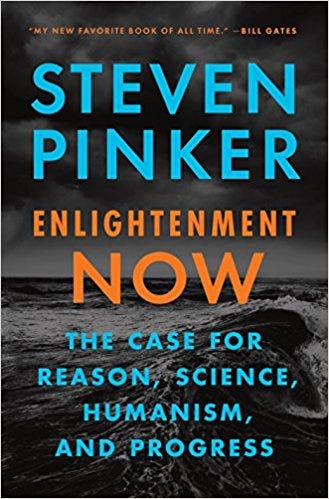
The poor have more technology now than the rich could have even dreamed of 150 years ago, We have better nutrition, stimulation, sanitation, and education, and our IQs have risen by 30 points in the last 100 years. That means that someone with an average IQ of 100 these days would have been considered a genius who was more intelligent than 98% of the population just a century ago.
We are 200 times less likely to die from war than in the early 1940s, 96% less likely to die in a car crash, 95% less likely to die while at work, and 92% less likely to die in a fire. Even nuclear weapons have decreased by 85%, thanks to the joint efforts of the US and Russia to give up on their arms race (Pinker, 2018).
Some say that our health is worse, but then why do we keep living longer than ever? The average life expectancy around the globe continues to rise, with some African countries increasing their life expectancy by more than ten years across the last decade. Individuals in these countries are therefore no closer to their death even though they are now ten years older!
Some say that we have become more isolated and lonely. Most notably, a sociologist, Robert Putnam, wrote the best-selling book ‘Bowling Alone’. In this book, he explains that our social capital has declined since its peak in 1964. According to Putnam’s extensive data, we engage less in community life, see friends less, join clubs less, play sport less and generally do more things alone than we ever have before. We also watch a lot of television. As a result, Putnam says that we are suffering from higher rates of suicide and mental health disorders than ever before.

It turns out that this may not be true, however. While we have a greater awareness of mental health conditions than we had in the past, we also have more people talking about their difficulties and seeking help. So, although rates of depression and anxiety are increasing in some surveys, this could mean a higher social acceptance of these conditions and a reduction of stigma around personally admitting to having mental health difficulties.
Support for improved well-being across time is provided again by Pinker when he found that between 1981 and 2007, 45 out of 52 countries assessed exhibited higher rates of happiness in 2007 than they did in 1981. Loneliness also appears to be declining since 2000, at least amongst US college students (Pinker, 2018). So maybe the internet, smartphones and social media aren’t that bad for us after all?

There is still a long way to go, but we are further along the path towards enlightenment than we have ever been in the past, which gives me optimism for the future. In addition, not watching the nightly news helps me see things how they are, rather than the fear and rage that media companies like to sell us.
With the COVID-19 pandemic, it was easy to glorify the past before the world stopped and coronavirus turned things upside down. However, things were not always peachy before 2020. So, instead of just trying to rebuild the past, let’s create the best future that we can for as many people as possible.
Dr Damon Ashworth
Clinical Psychologist


 Damon Ashworth Psychology
How can I help?