I used to lie a lot growing up. Not quite as bad as Holden Caulfield in ‘The Catcher in the Rye’:
“I’m the most terrific liar you ever saw in your life. It’s awful. If I’m on my way to the store to buy a magazine, even, and somebody asks me where I’m going, I’m liable to say I’m going to the opera. It’s terrible.”
― J.D. Salinger, The Catcher in the Rye

I remember lying to my mum about cleaning my room to go outside to play. So instead, I would push all the mess under the bed or throw it in the wardrobe.
I remember lying about doing my homework so that I didn’t have to do it and could play video games. I would then lie about being sick the next day to finish the assignment I needed to do the night before.
I remember lying about how many points I scored in basketball to friends or how many alcoholic drinks I had to my parents whenever they picked me up from a high school party.
I even remember lying to my brother’s friend about my surfing skills (I didn’t have any) and to a classmate about how many languages I spoke (I can say maybe 30 words in Indonesian, Spanish, and Italian, but not much more).
I think back to these moments, and I’m not proud of saying these things, but I can also understand why I did it.
I wish I could have been a less lazy, more confident and self-assured kid who was always honest with his friends and strangers and did the right thing by his parents and teachers. But how realistic is that scenario, and is it even ideal?
“The truth is always an insult or a joke. Lies are generally tastier. We love them. The nature of lies is to please. Truth has no concern for anyone’s comfort.”
― Katherine Dunn, Geek Love

Why Do People Lie?
We lie to:
- fit in and pretend we are like others
- stand out and pretend we are different to or better than others
- seek approval from others
- be seen as more loveable/desirable/acceptable
- feel better about ourselves
- avoid getting into trouble
- protect other people’s feelings or avoid hurting them
- be polite
- avoid feeling hurt, sad, disappointed, guilty or ashamed
- keep a secret
- maintain confidentiality
- be consistent with societal norms
“I’m not upset that you lied to me, I’m upset that from now on I can’t believe you.”
― Friedrich Nietzsche
What Happens if We Are 100% Honest?

Jim Carrey plays the main character in the 1997 comedy ‘Liar Liar’. He’s a high flying lawyer who keeps disappointing his son Max by making promises to him that he doesn’t keep by putting work first. Finally, after his dad doesn’t turn up to his birthday celebration, Max wishes for his dad not to be able to tell a lie, and the magic of movies makes this wish come true.
What results is some hilarious situations in which Jim Carrey’s character gets himself into trouble for telling the whole truth when it would be more polite to lie. It includes telling his secretary why he didn’t give her a pay rise, telling his boss that he has had better than her, and confessing to everyone in a crowded elevator that he was the one who did the smelly fart.
The moral of the story was two-fold:
- Sometimes it is necessary to lie, or at least not always be brutally honest and say everything that comes to your mind, and
- By being tactful and as honest as possible, you may become a better person who upsets people less and has more authentic relationships.
“One lie has the power to tarnish a thousand truths.“
― Al David
Radical Honesty
In 2007, A.J. Jacobs wrote an article for Esquire magazine about a month-long experiment on a movement called Radical Honesty. It was titled ‘I Think You’re Fat’ and is worth reading. Much more than the 1995 book called ‘Radical Honesty’ by Brad Blanton that initially inspired the article:
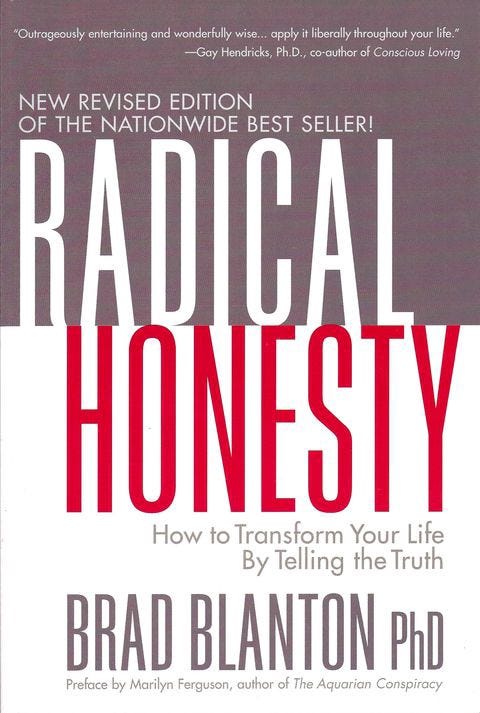
Blanton had worked as a psychotherapist for 35 years in Washington D.C. and ran 8-day workshops on Radical Honesty that retailed for $2,800 back in 2007. Blanton says his method works, although he may distort some of the positive benefits for personal and financial gain. He’s been married five times and claims to have slept with more than 500 women and six men, including a “whole bunch of threesomes.” He also admits to lying sometimes.
“She looks honestly upset, but then, I’ve learned that I can’t read her. The problem with a really excellent liar is that you have to just assume they’re always lying.“
― Holly Black, Black Heart

I Think You’re Fat
In Jacobs article, he wasn’t overly optimistic about Blanton’s version of Radical Honesty either. If we didn’t have a filter between what we say and what we notice in the world, in our body and our thoughts like Blanton advocates, the results would probably be less funny and more consequential than what happened to Jim Carrey in ‘Liar Liar’. He declares:
“Without lies, marriages would crumble, workers would be fired, egos would be shattered, governments would collapse.” — A.J. Jacobs
Jacobs found it impossible not to tell a lie during his month-long experiment but did cut down his lying by at least 40%. But unfortunately, he also scared a five-year-old girl, offended numerous people, and spoke about sex and attraction to the point where he felt creepy.
On the positive, being radically honest did save Jacobs time, resulting in him having to talk less to the people he didn’t want to talk to and do less of the things he didn’t want to do. In addition, it saved him mental energy by not having to choose how much he would lie or massage the truth. It also meant that people were usually more honest with him in return, and he found out that his relationships could withstand more truth-telling than he expected. So, similar to the ‘Liar Liar’ take-away message, Jacobs concluded:
- Being radically honest all the time and never having a filter is likely to be inappropriate in many settings and lead to more confrontations with others, and
- We could probably benefit by being more authentic, honest and truthful with others, especially in intimate relationships, as secrets tend to weigh us down.
“There is beauty in truth, even if it’s painful. Those who lie, twist life so that it looks tasty to the lazy, brilliant to the ignorant, and powerful to the weak. But lies only strengthen our defects. They don’t teach anything, help anything, fix anything or cure anything. Nor do they develop one’s character, one’s mind, one’s heart or one’s soul.”
― José N. Harris
What is a Lie?
In his interesting small book ‘Lying’, Sam Harris defines a lie as:
“Anything that is done to intentionally mislead others when they expect honest communication.” — Sam Harris

Omission vs Commission
In ‘Lying’, Sam Harris distinguishes between lies of commission, where the person is active in their intent to deceive, and the more passive act of omission, where the person fails to do something or say something they probably should. Both are deceptive and misleading to the audience who is the target of the action or lack of action.
Harris believes that lies of commission are a more serious violation of ethics and likely to be more harmful. It is similar to how pushing someone in front of a train is a more serious ethical violation than not saving someone who was hit by a train when you had a chance to do so.
Harris argues for people to stop all forms of commission and says that we can enhance our world, build trust and improve relationships by always being honest in our communication. While he believes that omission is also lying, he does not think that we can or should eliminate all forms of omission. Instead, he says that “skilful truth-telling” is sometimes required to be both honest and tactful in our words and avoid causing unnecessary harm.
Let’s look at the following three examples to see the difference between radical honesty, lying and skilful truth-telling.

SCENARIO ONE: Your husband asks if he looks fat in an outfit that you honestly believe isn’t flattering for him. You could say:
A) “Yeah. You do look fat. I’d say about 10 pounds overweight. Maybe you should skip dessert for a while.”
B) “Not at all, sweety. You look amazing!”
C) “You look nice, but I think I prefer the black jumper and blue jeans I bought you a few weeks ago. Want to try that one and see which one you feel better in?“

SCENARIO TWO: Your sister and her family are in town for the week and have decided to stay at your place for the whole time because they want to save money. You don’t dislike them, but you’d prefer to be catching up on your work that you are behind on. On night four, she notices you are a little tense and asks if you mind them staying there. You could say:
A) “I do. I wish you weren’t so tight and could have paid for a hotel if you planned to stay more than three nights. A week is pushing it, and I’d prefer you left.”
B) “Mind? Are you kidding? I love it. The more, the merrier, I always say! Stay for as long as you’d like.”
C) “It’s a busy week for me in terms of work, so it wasn’t ideal timing for me. If I seem a bit tense, I’m sorry. I do want to be able to help you guys out because family means a lot to me.“

SCENARIO THREE: You’ve been unemployed for six months and get a job interview to wait tables at a restaurant in town. You’d ideally prefer an acting job. The restaurant boss asks what your career plans are, as they want to hire someone who will stick around. You could say:
A) “Well, acting has always been my passion, so this is just a stop-gap job to pay the bills and put food on the table. I couldn’t care less about the job or your restaurant. I want a regular paycheck so that I can pay my rent and bills until I get a real job.”
B) “I’d love to become a professional waiter. I’ve always thought that providing great service to people is my calling in life, and I plan to stick around for at least five years and show everyone just how amazing your restaurant is. So I’m in it for the long haul.”
C) “I’m not too sure about what will happen with my career, but at this stage, I’d like to be able to work here. I am available seven days a week and will put in 100% effort whenever I am on shift. I am also willing to learn whatever skills are required, and I can promise that I will give you as much notice as possible if my plans ever do change in the future.“
In each scenario, A is the radically honest response, B is the active lying or commission response, and C is the skilful truth-telling response. Some truths are unsaid in the C responses, which is technically a lie of omission.
Many people still believe that omissions are a big no-no:
“When truth is replaced by silence, the silence is a lie.”
― Yevgeny Yevtushenko“A lie that is half-truth is the darkest of all lies.”
― Alfred Tennyson“At times to be silent is to lie. You will win because you have enough brute force. But you will not convince. For to convince you need to persuade. And in order to persuade you would need what you lack: Reason and Right.”
― Miguel de Unamuno“People think that a liar gains a victory over his victim. What I’ve learned is that a lie is an act of self-abdication, because one surrenders one’s reality to the person to whom one lies, making that person one’s master, condemning oneself from then on to faking the sort of reality that person’s view requires to be faked…The man who lies to the world, is the world’s slave from then on…There are no white lies, there is only the blackest of destruction, and a white lie is the blackest of all.”
― Ayn Rand, Atlas Shrugged

Is it Ever Helpful to Lie to Ourselves?
The short answer is yes. It is psychologically healthier to be slightly optimistic rather than entirely realistic. Research indicates that people with depression are often more realistic in their appraisals of situations and other people’s judgments than people without depression. Most “healthy people” believe that they are better drivers, more intelligent, better workers, better parents, and better lovers compared to the average person.
People lie to themselves because they like to feel that they are important and maybe more unique or special than they are. To prove this point, how would you feel if someone told you that you were just “average”? People also like to see themselves as good people who behave in particular ways for sound reasons. Even people that consistently cause harm to themselves or others.
Anyone with an unhealthy addiction becomes an expert at lying to themselves and others. This secrecy and dishonesty only further fuel the sense of depression, shame and guilt that people with addiction feel. As long as they are in touch with the truth of the situation and the consequences of their actions. Most addicts are not, however, thanks to in-built defence mechanisms.
Defence mechanisms are mostly subconscious or unconscious methods that we engage in to protect our ego or positive sense of self. Some of the more famous ones are denial, humour, repression, suppression, rationalisation, intellectualisation, projection, displacement and regression. My personal favourite is reaction formation (click here for a full description of these defence mechanisms and how to identify yours). Most people will deny engaging in defence mechanisms if you ask them directly about it, but they’ll tell you that others do. The reality is we all lie to ourselves at times, and maybe we need to lie to maintain a “healthy” outlook on ourselves, others, the world and our future.
“The visionary lies to himself, the liar only to others.”
― Friedrich Nietzsche“I lie to myself all the time. But I never believe me.”
― S.E. Hinton, The Outsiders“The best lies about me are the ones I told.”
― Patrick Rothfuss, The Name of the Wind“Anybody who says they are a good liar obviously is not, because any legitimately savvy liar would always insist they’re honest about everything.”
― Chuck Klosterman

So What Can We Do?
The most accurate recommendations that I could find on lying were also some of the simplest:
“If you don’t want to slip up tomorrow, speak the truth today.”
― Bruce Lee
“If you tell the truth, you don’t have to remember anything.“
Mark Twain
I agree with Sam Harris that it is a worthwhile aim to never be actively dishonest. Furthermore, this approach is consistent with one of Jordan Peterson’s better rules from his ’12 Rules for Life’ book — Rule #8: “Tell the truth — or, at least, don’t lie“
The philosopher Robin Devenport wouldn’t agree with either Harris or Peterson. He states:
“it is impossible for anyone to be truly honest about many things, as long as he (or she) carries biased perspectives, hidden resentments, unresolved longings, unacknowledged insecurities, or a skewed view of self, to name just some inner human conditions… if absolute honesty is impossible, then we are all liars by nature, at least to a degree.”
Dan Ariely concludes in his excellent book ‘The Honest Truth about Dishonesty’ that we all tend to lie to everyone, especially ourselves. We lie only as much as we know we can get away with, but not so much that it becomes hard to keep seeing ourselves as good people.
Devenport continues:
“Perhaps the best we can do, then, is only to lie in ways that are intended to promote another’s well-being or spare her unnecessary pain, and so further our integrity. The ‘noble liar’ is someone who tries to live by good intentions, even if that means intentionally lying to another person, if doing so is the lesser of two evils…Before we cast too harsh a judgment on the liar, let’s first understand what his motives are.”
Robin Devenport
We all need to be as honest as we can, especially with those we love and make sure that it is for a good reason when we lie. We also need to realise that it will never be possible to be 100% honest about everything to anyone, including ourselves, and that is okay. Other people won’t be 100% honest with you or themselves either, which doesn’t make them bad people. It’s what we lie about and why that matters.


 Damon Ashworth Psychology
Leave a reply to deepanilamani Cancel reply